
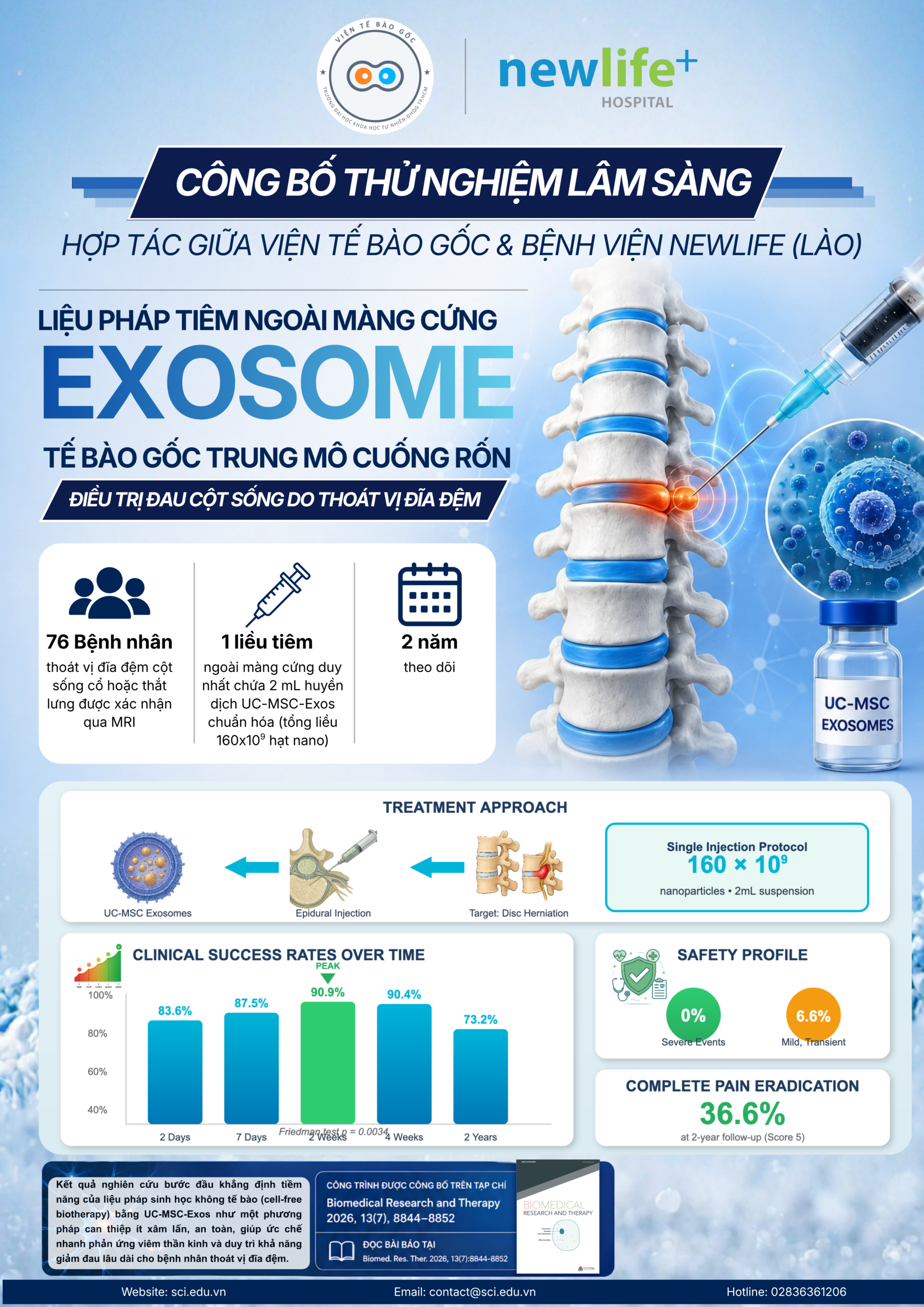
Công trình nghiên cứu hợp tác giữa Bệnh viện NewLife (Vientiane, Lào) và Viện Tế bào gốc, Trường Đại học Khoa học Tự nhiên, ĐHQG-HCM vừa được xuất bản trên tạp chí Biomedical Research and Therapy (2026, 13(7), 8844–8852) với tựa đề: “Epidural Injection of Umbilical Cord-Derived Mesenchymal Stem Cell Exosomes for Chronic Spinal Pain: A Preliminary Clinical Evaluation”.
Nghiên cứu đánh giá tính an toàn, tính khả thi lâm sàng và hiệu quả giảm đau dài hạn của liệu pháp tiêm ngoài màng cứng exosome có nguồn gốc từ tế bào gốc trung mô dây rốn người (UC-MSC-Exos) trên bệnh nhân đau cột sống mạn tính do thoát vị đĩa đệm (IVDH) đã kháng với thuốc giảm đau kháng viêm không steroid (NSAIDs).
Những phát hiện nổi bật của nghiên cứu:
- Thiết kế lâm sàng: Thử nghiệm nhãn mở theo dõi dọc trên 76 bệnh nhân thoát vị đĩa đệm cột sống cổ hoặc thắt lưng được xác nhận qua MRI. Mỗi bệnh nhân nhận một liều tiêm ngoài màng cứng duy nhất chứa 2 mL huyền dịch UC-MSC-Exos chuẩn hóa (tổng liều
hạt nano) và được theo dõi trong 2 năm.
- Hồ sơ an toàn cao: Không ghi nhận bất kỳ biến cố bất lợi nghiêm trọng nào về toàn thân, thần kinh hay nhiễm trùng (0%) trong suốt 2 năm theo dõi. Chỉ 6,6% bệnh nhân có cảm giác đau nhẹ thoáng qua tại vị trí tiêm và tự thoái lui trong vòng 24–48 giờ.
- Hiệu quả giảm đau nhanh và bền vững: Tỷ lệ thành công lâm sàng đạt 83,6% chỉ sau 2 ngày tiêm, đạt đỉnh 90,9% ở tuần thứ 2, duy trì 90,4% ở tuần thứ 4 và giữ vững ở mức 73,2% tại thời điểm 2 năm. Đặc biệt, có 36,6% bệnh nhân ghi nhận hết đau hoàn toàn sau 2 năm.
- Tính đồng nhất: Mức độ cải thiện triệu chứng có ý nghĩa thống kê theo thời gian (
) và độc lập với tuổi tác, giới tính cũng như vị trí giải phẫu của khối thoát vị (
).
Kết quả nghiên cứu bước đầu khẳng định tiềm năng của liệu pháp sinh học không tế bào (cell-free biotherapy) bằng UC-MSC-Exos như một phương pháp can thiệp ít xâm lấn, an toàn, giúp ức chế nhanh phản ứng viêm thần kinh và duy trì khả năng giảm đau lâu dài cho bệnh nhân thoát vị đĩa đệm.
Chi tiết bài báo được đăng tải tại: Biomed. Res. Ther. 2026, 13(7):8844-8852.
Clinical Trial Published on Epidural Injection of Umbilical Cord MSC-Derived Exosomes for Chronic Discogenic Spinal Pain
A collaborative clinical study between NewLife Hospital (Vientiane, Lao PDR) and the VNUHCM-US Stem Cell Institute (University of Science, Vietnam National University Ho Chi Minh City) has been published in Biomedical Research and Therapy(2026, 13(7), 8844–8852), titled: “Epidural Injection of Umbilical Cord-Derived Mesenchymal Stem Cell Exosomes for Chronic Spinal Pain: A Preliminary Clinical Evaluation”.
The prospective study evaluates the safety, clinical feasibility, and longitudinal analgesic efficacy of epidural administration of human umbilical cord-derived mesenchymal stem cell exosomes (UC-MSC-Exos) in patients suffering from chronic cervical or lumbar discogenic pain refractory to non-steroidal anti-inflammatory drugs (NSAIDs).
Key Findings:
- Clinical Trial Design: A prospective, open-label trial followed 76 patients with MRI-confirmed cervical or lumbar intervertebral disc herniation (IVDH). Each participant received a single epidural injection containing a 2 mL standardized UC-MSC-Exo suspension (160 x 109 total nanoparticles) and was monitored over a 2-year longitudinal follow-up period.
- High Safety Profile: No severe systemic, neurological, or infectious adverse events (0%) occurred throughout the 2-year observation. Only 6.6% of patients experienced mild, transient injection-site discomfort that resolved spontaneously within 24 to 48 hours.
- Rapid and Durable Pain Alleviation: The clinical success rate reached 83.6% within 2 days post-intervention, peaked at 90.9% at 2 weeks, remained high at 90.4% at 4 weeks, and was sustained at 73.2% at the 2-year milestone. Notably, 36.6% of patients achieved complete pain eradication at 2 years.
- Consistent Response Across Subgroups: Pain alleviation was statistically significant over time (p = 0.0034) and independent of patient age, sex, or anatomical lesion segment (p > 0.05).
These initial findings demonstrate the clinical potential of cell-free biotherapy using standardized UC-MSC-Exos as a safe, minimally invasive intervention that rapidly suppresses neuroinflammation and confers durable long-term pain relief in intervertebral disc herniation.
Read the full open-access article at: Biomed. Res. Ther. 2026, 13(7):8844-8852.
Leave a Reply